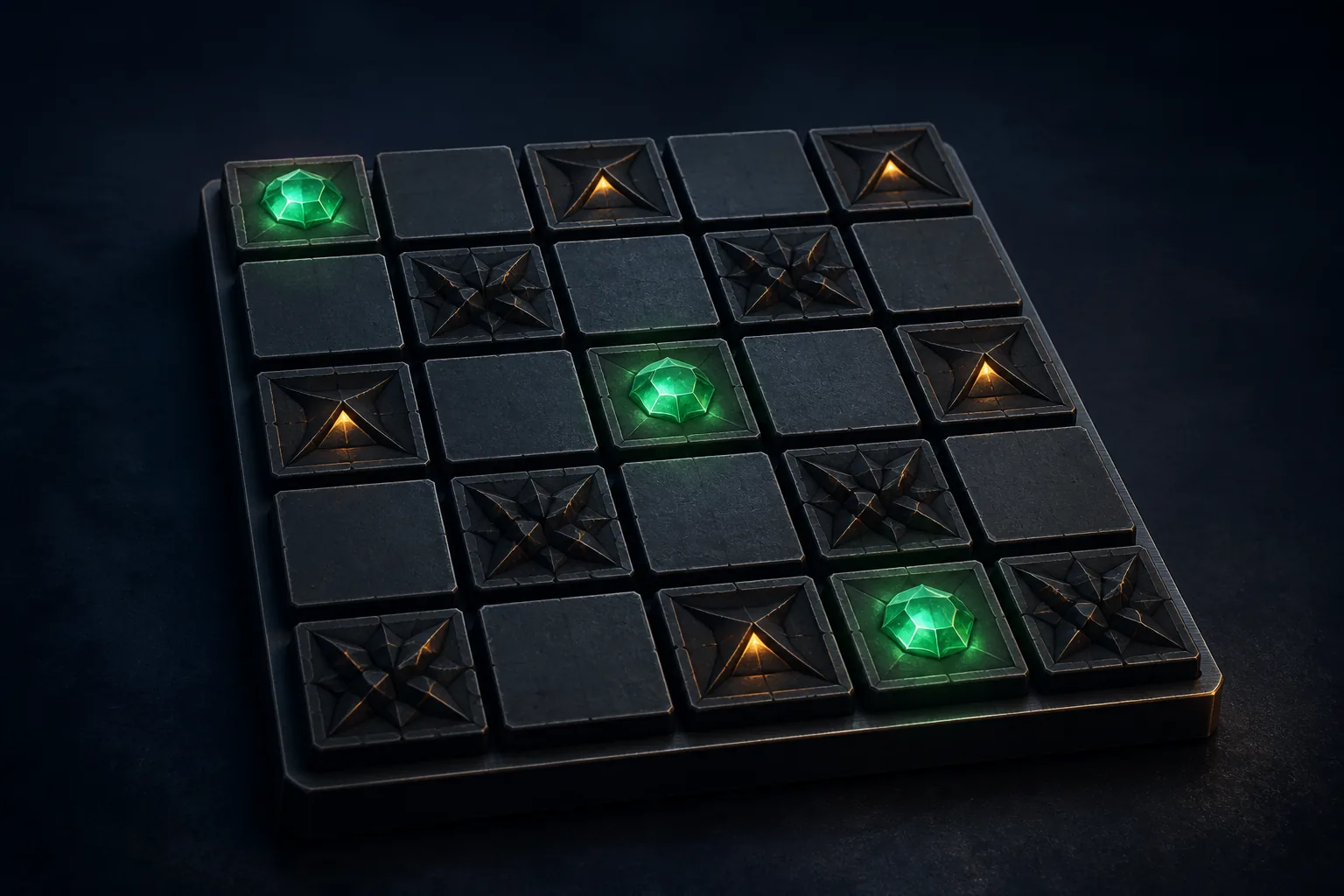
5×5 BOARD / WITHOUT REPLACEMENT
Stake Mines: mechanics and probability
No tile position is inherently safer. Once the mine count and number of revealed safe tiles are known, combinations determine the next-step and consecutive-success probabilities. This review separates the mathematics from strategy claims.
当サイトの第二の入口
広告 · アフィリエイトリンク · 20歳以上
出金で待たされるのが嫌なら、入口を二つ持っておく
出金が止まる理由は運営の親切さではなく、お金がどの経路を通るか、審査が自動か人の目か、書類をいつ求めるかの三つで決まります。1winは仮想通貨と電子決済を主軸に置いていて、本人確認を先に通しておけば申請から着金までが短く収まります。カジノとスポーツが同じ残高で動くので、口座を増やさずに遊ぶ先を変えられます。
- 仮想通貨の出金は申請から数分〜数十分
- 入金ボーナスは初回から段階式
- カジノとスポーツが同じ残高
- Aviator・Plinko系のクラッシュゲーム
- ライブテーブルは24時間開いている
- 日本語の画面とサポート
ボーナス条件・アフィリエイトの開示・20歳以上の注意
広告表記。この枠は独立した情報サイトの中に置かれた商業スペースです。ステークガイドは1winの運営元ではなく、Stakeの運営元でもありません。上のリンクはアフィリエイトリンクで、ここから登録や入金が発生すると当サイトに紹介料が支払われます。読者の支払額は変わりませんし、サイト本文の検証内容や評価はこの枠の有無で変わりません。表示しているボーナスは運営側が決めるものです。倍率、最低入金額、賭け条件(出金条件)の倍数と掛け先、消化率、有効期限、対象外ゲーム、最大ベット額、最大出金額、本人確認(KYC)の要否は、入金する前に運営側の利用規約ページで必ず自分で確認してください。販促の数字は予告なく変わるため、検索結果やまとめ記事で見た条件が既に終了していることがあります。20歳未満の方は利用できません。他人の名義や書類で登録する行為は禁止されています。賭けは期待値がマイナスの娯楽であり、収入の手段でも、負けを取り戻す方法でもありません。始める前に上限額を決め、負けを追いかけず、生活費や借入金を使わないでください。遊ぶ時間や金額を自分で止められないと感じたら、プラットフォーム側の入金上限と自己排除の機能を使い、お住まいの自治体の精神保健福祉センター、または依存症の相談窓口に相談してください。日本国内では私設の賭博は刑法で禁じられており、海外のライセンスは国内での適法性を保証しません。利用の判断は各自の責任で行ってください。
- Board
- 5×5
- 25 tiles total
- Mines
- 1 to 24
- selected before a round
- Published RTP
- 99.00%
- checked 2026-09-01
- House edge
- 1.00%
- long-run theory
01
Translate the rules into probability
At the start, m of 25 tiles are mines and the rest are safe. Each safe reveal removes one safe tile from the unknown pool. Hitting a mine ends the round; after a safe tile, the user can stop or select again.
The visual position carries no information under the published model. Corners, centres and tiles next to a previous safe result all have the same prior chance at a given step. A selection pattern may structure behaviour, but it does not improve the probability.
- More mines increase first-pick failure probability
- Each safe reveal increases the mine share among unseen tiles
- Stopping earlier changes variance, not the published house edge
02
With three mines, five safe picks occur about 49.565% of the time
With three mines, the first-pick safe probability is 22/25, or 88%. Three consecutive safe picks fall to about 66.957%, and five to about 49.565%. Picks within one board are dependent, but wins and losses on an earlier board do not make a new board hot or cold.
Payouts are built near the inverse of success probability and then reduced by the operator margin. A published 99% RTP means a theoretical 99% return across an extremely large number of equivalent wagers, not a 99% refund on a particular board.
03
What provably fair can and cannot prove
A provably-fair process combines inputs such as a committed server seed, a client seed and a nonce. Revealing the server seed later lets a reviewer verify the earlier hash and reproduce the outcome.
This can show that the specified inputs reproduce the board. It does not guarantee profit, a favourable next board or short-run convergence to RTP. Verifiability and positive expected value are different claims.
04
Separate common strategy claims from the model
Opening corners first, avoiding the row that held the previous mine, or increasing the wager after a loss does not add information about a newly generated board. Bet progression changes the size and timing of swings, not expected value per unit wagered.
The measurable inputs are mine count, number of intended picks, displayed multiplier, published RTP and loss limit. Reframing the question from ‘which tile wins’ to ‘which probability and loss range am I selecting’ removes most of the illusion of control.
MODEL
Probability of k consecutive safe picks
Here m is the mine count and k is the number of non-repeating selections. Revealed tiles are not replaced, so the correct model uses combinations rather than one fixed probability raised to a power.
P(safe k picks) = C(25 − m, k) ÷ C(25, k) DATA
Reference table
| Mines | 1 pick | 3 safe | 5 safe |
|---|---|---|---|
| 1 | 96.000% | 88.000% | 80.000% |
| 3 | 88.000% | 66.957% | 49.565% |
| 5 | 80.000% | 49.565% | 29.181% |
| 10 | 60.000% | 19.783% | 5.652% |
CALCULATOR
Change mine count and intended picks
The tool shows theoretical success probability and a reference multiplier after a 1% edge. Displayed payouts may differ through rounding or product changes.
The calculator is an educational model, not a prediction or a recommendation to gamble.
FAQ
Mines probability FAQ
Are some tile positions safer?
Not under the published model. A corner or centre selection does not reveal additional information about the hidden board.
What is the first-pick chance with three mines?
There are 22 safe tiles, so it is 22/25, or 88%. Five consecutive safe picks are about 49.565%.
Does 99% RTP return 99 for every 100 wagered?
No. RTP is a long-run theoretical average. A single board can lose the full wager.
Can Martingale remove the house edge?
No. A staking progression changes variance and ruin risk, not expected value.